
The endurance and influence of art is celebrated throughout Greece, but especially in Athens,
where the writers and sculptors of ancient Greece continue to spark our imaginations.
A visit to the National Archaeological Museum is a must for anyone visiting this city.

We started before sunrise in a most beautiful breakfast location
the rooftop restaurant of the Athens Gate Hotel
overlooking the Acropolis.

As you enter the first room of the National Archaeological Museum
you see the death masks of an ancient Mycenaean royal family.
The archaeologist who discovered this group of graves thought he had found the burial circle for King Agamemnon,
a leader of the 10-year siege of Troy, described in The Iliad.
{When he returned from the Trojan War with his prize Cassandra
Agamemnon was murdered by his wife Clytemnestra and wife's lover Aegisthus.
They were later murdered in revenge by his son Orestes and daughter Electra.
And we think modern families are dysfunctional!}
Later analysis of the artifacts dates them to be before the time of Agamemnon
but they are amazing finds more than 3000 years old.

The ancient Mycenaeans covered the bodies of their loved ones in gold plate, an action I can understand.
They were probably influenced by the ancient Egyptians, who had similar rituals.
Our girls were fascinated with the baby masks.

I preferred the gold crowns and clothing trims.
This room was dazzling once I realized the items were solid gold and absolutely ancient.

There were also rooms full of pottery, weapons and other artifacts, well preserved and maintained.

We even found a 4500-year-old hedgehog for Carlee - still cute.

These ancient stone statues inspired Picasso.
The fiddle-shaped pieces were models for shields.

And of course I like these ancient musicians.

Next, we found the rooms that prompted Carlee to complain, "Why does Mom take so many pictures of naked people?" Beauty is in the eye of the beholder.
There were numerous examples of the Korai and Kouroi - female and male statues sculpted from around 600 to 490 BC.
Many of these were found around the Acropolis, depicting devotees to the Goddess Athena.
The young ladies dress modestly, while the lads show off their youth and virility.

The classical period of Greek sculpture began after Athenian victories in the Peloponnesian Wars, when the best-known statues were created in Marble and Bronze.
This one of Poseidon or Zeus was found in the remains of a shipwreck.

I think this statue of Aphrodite graced one of my college textbooks

Check out those external obliques, Carlee!

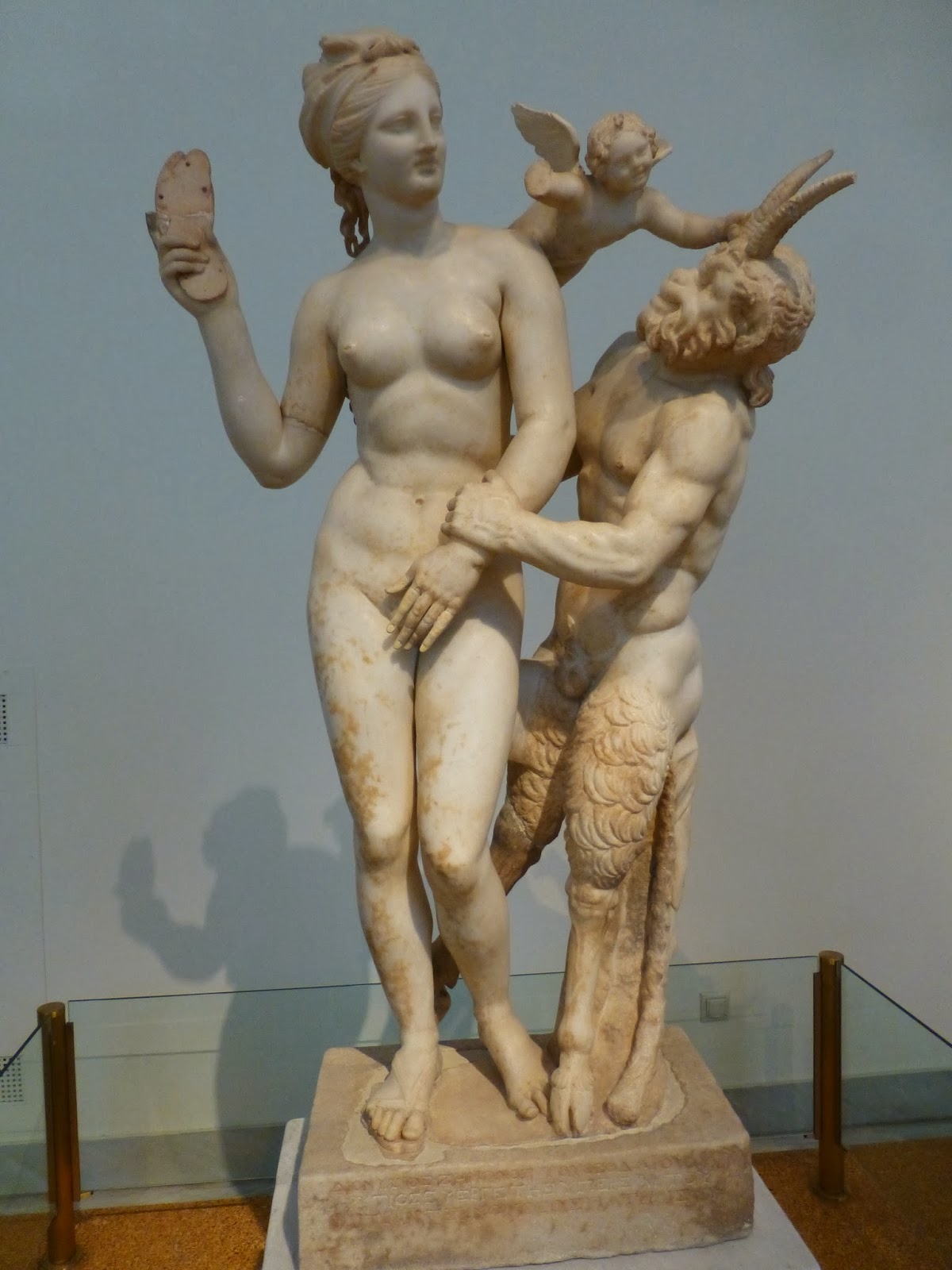
Here Pan tries to seduce Aphrodite, who is fending him off with her shoe.
Little Eros tries to help her.
I always felt sorry for the Minotaur.

There are several rooms full of funerary art - depictions of everyday (wealthy) Athenians, rendered for their burial vaults.
The themes are similar, with family members mourning a loved one
as they are welcomed to the afterlife by ancestors or gods.
I was moved by the emotion depicted in these sculptures - imagine mourning a person who died 2300 years ago!
Such is the power of art.

The Antikythera Shipwreck is a temporary exhibit of artifacts that went down around 50-60 BC.
What does 2000 years in seawater do to bronze? See this statue believed to be Perseus or Paris:

Marble is a different story. This statue landed head-first in the sand, with shocking results:

A roomful of these statues reminded me of the crew of Davy Jones' ship
in Pirates of the Caribbean 2-3.

Can you imagine finding these on the bottom of the ocean?

Archaeologists think this was supposed to be Odysseus -
an appropriate rendition considering his long journey and many years on/in the sea.

And Achilles, before his long sojourn in the Land of the Shades.

The Antikythera Shipwreck shows the trade in ancient Greek art that began during the Roman Empire.
The Romans greatly admired the artwork and ideas they found in Greece.
They copied the sculpture, the myths, and some aspects of the democratic government -
all of which were passed to future generations and reconstituted in the New World
when the United States of America built her constitution and capitol.
This admiration saved Greece from being completely dominated by the Italians at any point in their history
even when Italy controlled Greek islands and mainland.
Today, the Greeks still benefit from on their ancient artists, as tourism is a major industry for the country.

The lasting power of art...and seawater!


